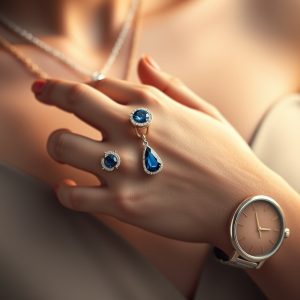
The Gilded Cartography: How Fine Jewelry Maps the Uncharted Territories of the Soul

There exists a quiet alchemy in the way a sapphire pendant catches the light, its deep blue facets refracting not just color but the weight of unspoken emotions. Jewelry, in its most transcendent form, is not merely an accessory—it is a cartographer’s tool, sketching the contours of the soul’s most intimate landscapes. Each piece, whether a diamond necklace draped like starlight across a collarbone or a vintage jewelry heirloom passed down through generations, carries the latent power to chart the unseen: the dreams we dare not voice, the sorrows we bury deep, and the triumphs we wear like invisible crowns.
The Silent Geography of Gemstones
Consider the emerald ring, its verdant glow a whisper of ancient forests and untamed wilderness. Emeralds, with their inclusions—flaws that gemologists call “jardin”—are not imperfections but topographical maps of their own formation. They tell stories of pressure and time, of the earth’s slow, relentless sculpting. When set into a ring, an emerald becomes a compass, guiding the wearer through the labyrinth of their own complexities. It is no coincidence that Cleopatra adored emeralds; she understood that their brilliance was not just in their color but in their ability to mirror the depth of human experience.
Similarly, a ruby brooch pinned to a lapel is not merely a splash of crimson but a waypoint on the journey of the soul. Rubies, with their fiery intensity, have long been associated with passion and vitality. In medieval times, they were believed to protect warriors in battle, not by rendering them invincible, but by reminding them of what they fought for—love, honor, the intangible things that make life worth living. A ruby brooch, then, is a talisman, a marker on the map of one’s life, signaling a moment of courage, a burst of creativity, or a love that burned as brightly as the gem itself.
The Architecture of Memory
Jewelry is also an architect, constructing monuments to memory in the most delicate of forms. A pearl earring, with its lustrous surface, is not just a symbol of elegance but a vessel for nostalgia. Pearls form in response to irritation, a grain of sand or a parasite that the oyster transforms into something luminous. In this way, they are metaphors for resilience, for the way we take our wounds and shape them into something beautiful. When a woman wears pearl earrings, she is not just adorning herself; she is wearing her own quiet strength, a testament to the battles she has endured and the grace with which she has emerged.
Then there are the wedding bands and engagement rings, those most sacred of jewelry pieces. They are not just circles of gold or platinum but the physical manifestation of a vow, a promise etched into metal and stone. The simplicity of a wedding band belies its complexity; it is a map of a shared journey, one that begins with a single step and spirals outward into a lifetime of moments—some joyful, some challenging, all held together by the unbroken circle of commitment. An engagement ring, with its central diamond or gemstone, is the starting point of this journey, a beacon that guides two souls toward a future they have yet to discover.
The Language of Light and Shadow
Fine jewelry speaks in a language of light and shadow, of presence and absence. A silver bracelet sliding down a wrist is not just a piece of metal but a play of contrasts—cool against warm skin, polished against matte, the way light dances along its surface. Silver, with its reflective qualities, has long been associated with the moon, with intuition, with the unseen forces that shape our lives. A silver bracelet, then, is a reminder to trust the journey, even when the path is shrouded in darkness.
In contrast, a gold ring is a declaration of warmth, of the sun’s life-giving energy. Gold does not tarnish; it endures, much like the bonds it often symbolizes. A gold ring is not just a piece of jewelry but a covenant, a promise to stand the test of time. Whether it is a simple band or an intricate design set with gemstones, a gold ring is a map of the heart’s most steadfast commitments.
The Unseen Compass
Perhaps the most profound aspect of jewelry is its ability to serve as an unseen compass, guiding us through the uncharted territories of our own souls. A platinum choker resting against the throat is not just an accessory but a statement of sovereignty, a reminder that the wearer is the author of their own story. Platinum, with its rarity and strength, is a metal that demands respect, much like the boundaries we set in our own lives. When worn, it becomes a silent declaration: “This is who I am. This is the path I choose.”
Even the most delicate pieces, like a crystal anklet or a gemstone tiara, carry this power. A crystal anklet, with its subtle chime, is a reminder to move through the world with grace and intention, to let our presence be felt in the most understated of ways. A gemstone tiara, often reserved for moments of celebration, is not just a crown but a symbol of the light within, a reminder that we all carry a spark of the divine, no matter how hidden it may be.
Jewelry, in all its forms, is a dialogue between the tangible and the intangible, the seen and the unseen. It is a map, a monument, a talisman, and a compass—all at once. To wear it is to acknowledge that the soul’s journey is not a straight line but a vast, intricate landscape, one that is as beautiful as it is complex. And in the quiet moments, when the light catches just right, it reminds us that we are not just travelers on this journey; we are the cartographers, sketching our own paths with every choice, every emotion, every piece we choose to wear.