
The Alchemy of the Stars: Crafting Jewelry from Ancient Meteorites and Cosmic Fragments
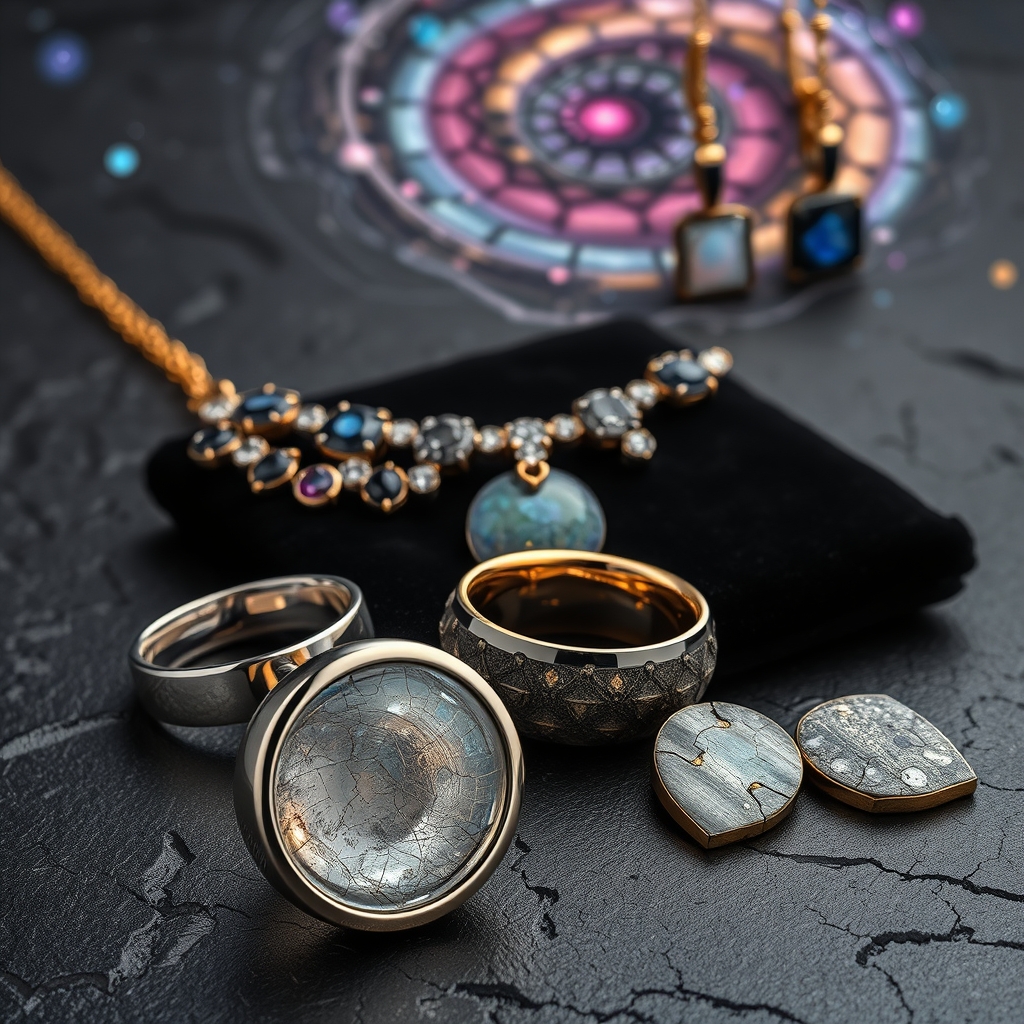
There is something inherently magical about wearing a piece of the universe. Not as a metaphor, but as a tangible, gleaming fragment of metal that once hurtled through the void of space before finding its way to Earth. Meteorite jewelry—rings, pendants, bracelets, and earrings forged from celestial debris—bridges the gap between the infinite cosmos and the intimate act of adornment. It is not merely jewelry; it is a conversation between time, space, and human curiosity.
The Cosmic Origins of Meteorite Jewelry
Meteorites are not just rocks; they are time capsules. Many of the meteorites used in jewelry, such as the Muonionalusta, Gibeon, Campo del Cielo, and Seymchan, are iron-nickel alloys that formed in the cores of ancient protoplanets billions of years ago. These celestial bodies shattered during the violent collisions that shaped our solar system, scattering their remnants across the cosmos. Some of these fragments eventually crossed paths with Earth, surviving the fiery descent through the atmosphere to land as meteorites.
The Muonionalusta, for instance, is one of the oldest known meteorites, dating back over 4.5 billion years—older than Earth itself. When sliced and etched, its interior reveals the mesmerizing Widmanstätten pattern, a geometric lattice of iron and nickel crystals that can only form in the zero-gravity environment of space over millions of years. This pattern is not just visually stunning; it is a fingerprint of the cosmos, unique to each meteorite and impossible to replicate on Earth.
The Artistry Behind Celestial Adornments
Transforming a rough meteorite into a piece of jewelry is a delicate alchemy that blends science, craftsmanship, and artistry. The process begins with careful selection—only the most stable and visually striking meteorites are chosen. Iron meteorites, in particular, are favored for their durability and the striking patterns they reveal when polished and etched with acid. The Campo del Cielo, a meteorite that fell in Argentina thousands of years ago, is prized for its high nickel content, which gives it a lustrous, silver-like finish when worked by skilled jewelers.
Once selected, the meteorite is cut into thin slices or shaped into cabochons, beads, or inlays. Jewelers must work with precision, as meteorites can be brittle and prone to oxidation if not properly treated. Some pieces are set in gold, platinum, or titanium to create rings, while others are suspended as pendants or earrings, allowing the meteorite to take center stage. The result is a piece of jewelry that carries the weight of its cosmic history while remaining wearable and elegant.
The Symbolism of Wearing the Cosmos
Meteorite jewelry is more than an aesthetic choice; it is a statement. For some, it represents a connection to the universe, a reminder of humanity’s place in the grand tapestry of existence. For others, it is a symbol of resilience—these meteorites have survived unimaginable journeys, and their endurance mirrors the strength of the wearer. Couples exchanging meteorite wedding bands often speak of the deeper meaning behind their choice: a bond as enduring and rare as the material itself.
There is also an element of mystery. Each meteorite carries within it the secrets of the early solar system, and wearing one is like holding a piece of the unknown. The Gibeon meteorite, for example, is believed to have originated from the core of a long-dead planet. When you wear a Gibeon meteorite ring, you are not just wearing a beautiful piece of jewelry; you are wearing a fragment of a world that no longer exists.
Beyond Meteorites: The Expanding Universe of Celestial Jewelry
While meteorites dominate the conversation around space jewelry, the category is expanding to include other celestial materials. Lunar and Martian meteorites—rare fragments of the Moon and Mars that were ejected during ancient impacts—are now being incorporated into high-end jewelry. These pieces are exceptionally rare, often selling for thousands of dollars per gram, but they offer an even deeper connection to the cosmos. Imagine wearing a pendant made from a rock that once sat on the surface of Mars, or a ring forged from a piece of the Moon.
Beyond meteorites, designers are also exploring the use of materials like moldavite, a tektite formed from the impact of a meteorite in what is now the Czech Republic. Moldavite’s emerald-green hue and swirling patterns make it a striking choice for pendants and earrings. There are also pieces inspired by the cosmos, such as galaxy necklaces that use swirling patterns of gemstones to mimic the appearance of distant nebulae, or star dust rings that incorporate tiny diamonds to represent the sparkle of the night sky.
The Future of Space Jewelry
As space exploration advances, so too does the potential for new materials and inspirations in celestial jewelry. Companies like NASA have already begun experimenting with 3D printing using regolith (lunar soil), and it may not be long before we see jewelry made from materials harvested directly from the Moon or asteroids. Private space missions and asteroid mining ventures could one day provide a steady supply of extraterrestrial materials, making space jewelry more accessible while preserving its exclusivity.
For now, meteorite jewelry remains a niche but growing market, appealing to those who seek something truly out of this world. Whether it’s a Muonionalusta ring passed down through generations, a Campo del Cielo pendant worn as a talisman, or a Gibeon meteorite band exchanged as a symbol of eternal love, these pieces carry a story that transcends time and space. They remind us that we are not just observers of the universe but a part of it, connected to the stars in ways we are only beginning to understand.
To wear a piece of meteorite jewelry is to carry a fragment of the infinite with you, a daily reminder that the cosmos is not just above us—it is within us, waiting to be discovered and cherished in the most personal of ways.